Friday, September 15, 2006

D.O.Q


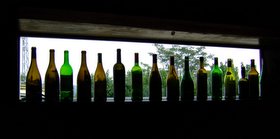
I feel as if I’ve just been let into the most wonderful secret. I have spent the last week in the wine producing areas of Priorat and Montsant in Catalonia in Spain.

All I knew about Spanish wine amounted to two words, Rioja and Cava. Then I read that Robert Parker had awarded wines from the Priorat marks in the high nineties and, as I was going that way anyway, it seemed like too good a chance to miss.

I’m not even going to pretend that I know a lot about wine. But it’s always interesting to see what your palate tells you about something you know nothing about.

The Priorat is a small DOQ region, surrounded by the crescent of the larger DO region of Montsant. Both are inland from Tarragona, south of Barcelona. The Priorat, which gets its name from the priory or monastery of the Carthusians at Scala Dei in the north of the region, is a land of harsh and beautiful mountain landscapes, of vines and olive trees, and a slate soil called ‘licorello’. Montsant has a greater soil diversity and its vines are allowed to produce a greater quantity of grapes. In Priorat sometimes only one kilo per vine is permitted, concentrating the flavour into powerful wines. The grapes are the traditional cariñena and garnacha, but now with quantities of syrah and merlot for structure. Anyone interested in learning more will find this article by Gerry Dawes extremely interesting.

The centre of Priorat production is the hilltop village of Gratallops, and, as luck would have it, there is a really good restaurant there, Los Irreductibles.

The kitchen is presided over by Ricardo Signore and the influence of Ferran Adria is evident throughout the menu. What is also great about this restaurant is that, firstly, there is no choice, you get what Ricardo has decided to cook. And secondly you can ask him to let you drink wine by the glass instead of having to order a bottle. So you get a glass of what he thinks will go best with what he has decided to cook. And when that is monkfish with fig confiture, or fillet of beef with foie gras and coffee, it is good to have someone else do the choosing! I think my favourite dish was a rich chocolate dessert with a coconut cream sauce and curry foam. The scent of the curry with the chocolate was wonderful.

Wine business is done in Falset, a busy little town on the main road to Reus. Wine people gather in the restaurants of El Cairat, El Celler de L’Aspic, Hostal de Sport and Mas Trucafort for Catalan specialities and more great wine.

South of Falset is one of the Montsant co-operatives at Els Guiamets, where the young winemaker, Eugenia Guasch, speaks excellent English and will show you round her Celler. The grapes were coming in the door in trailer loads as we talked. Montsant is a very young DO which already shows great promise, although it does not have the grandness, or the punch, of its stately neighbour in Priorat. The winemakers are young and enthusiastic and, typically, Eugenia’s top red wine, Isis, has a label designed by the current architect of the Sagrada Familia in Barcelona, and a strangely shaped bottle with a sloping back.

Most of the wine in both regions is red; the Priorat produces wines with tremendous concentration and power, redolent of wild black fruits, licorice and herbs. And they command high prices. The wines of Alvaro Palacios were on the restaurant menus for over €300, and fetch astronomical prices elsewhere. A big discussion is going on about the use of oak, and most of the good producers are cutting down on it. One of the ways they temper the new oak is by using it for their second wines, and also for the small amount of white wine produced. This gives the ordinary white wines a strong oaky taste, ok with food but a bit much without!

To the north of the region the mountains rise steeply; to the south the river Ebro marks the western edge and over to the east the region of the Penedes starts, with its massive Cava production.

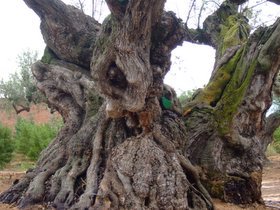
And that’s where the blog went next, not to drink Cava, but to see something quite unique…

Monday, September 04, 2006

The Oxford Symposium


This last weekend saw the twenty-fifth Oxford Symposium on Food & Cookery take place in the elegantly functional surroundings of St Catherine’s College Oxford. Designed, down to the door knobs and the fish in the ponds, by Arne Jacobsen in 1963 it is a calm yet surprising environment and it looks as if the Symposium will settle in here for the foreseeable future.

The topic under discussion this year was The Egg; star of the show was undoubtedly Prof Hervé This whose presentation on Molecular Gastronomy, complete with props of potentially explosive egg whites, brought the house down. I have never seen spread sheets excite so much delight. Wild hair, escaping shirt tails, flailing arms, comedy accent, we were entranced.

Papers were presented in parallel sessions so you had to make hard choices. I thought the participants would be an earnest and academic lot, intimidating as an assembly. They are serious, but not earnest, amateurs in the best sense of the word, and there were some fine presentations. Among those I saw I loved ‘Creating with Arctic Eggs’ given by Zona Spray Starks, about the fish eggs of the Arctic where she grew up. It was fascinating and really quite disturbing. I arrived at Michelle Toratani’s presentation on raw eggs just as she got to the word ‘mucilaginous’ and was sorry I missed what went before. Phyllis Thompson Reid gave a clever and sprightly paper - “the Ultimate in Cookery”: The Soufflé’s Rise and Feminism’s Second Wave – to an audience that converted the session into a vibrant discussion on Julia Child.

The food was excellent with menus and recipes by Caroline Conran and Anissa Helou. Egg oriented, but not so you would really notice!

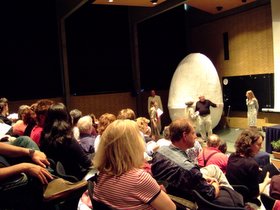
Carolin Young has a wonderful project to bring Salvador Dali’s idea for a giant hard boiled egg to fruition. Participants got into Blue Peter mode and stayed up half the night to make a papier maché model of the mould for this creation, which it is reckoned will take 153,400 eggs to make. The idea is to separate the eggs and whites and make a giant hard boiled egg. I had a really interesting discussion with a scientist about whether it would actually stand up once out of the mould, or whether it would collapse under its own weight. I think this pondering is an extension of the artistic idea. Prof This has however offered to provide a spray-on calcified surface to offer protection. This we have to see!

The people who came to the Symposium were an absolute delight. Please take a look at Jake Tilson’s book 'A Tale of 12 Kitchens' ( Weidenfeld & Nicolson) because you will love it. Not only did he write it, he designed the whole thing too, down to an original typeface. It is colourful and intriguing and begs to be read. I will be reviewing it in a later post.

Jeffery Steingarten was there and although my heart was a-flutter I did go and chat to him. Actually I went down on one knee.

So if you come next year you too will get to prop up the bar with Raymond Sokolov! Please come. All the people that write to me on this blog would love the Symposium. It’s open to all, the place is a gem, so just boogie on down to Oxford in 2007.

Wednesday, July 26, 2006

Wish you were here

The Blog has taken its bucket and spade to Cornwall...


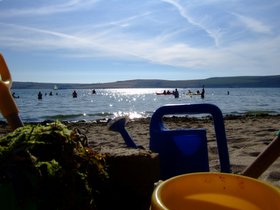
2006 is the centenary of the birth of John Betjeman, poet. He was a popular poet, in the sense that the people understood and loved him and he loved Cornwall, particularly the little church of St Enodoc, above the wonderful beach at Daymer, near Rock,(see above).

St Enodoc's Church was rescued in the nineteenth century from the sand that had engulfed it - in order to celebrate its consecration the vicar had to be lowered through a skylight - and now stands in the middle of a rather posh golf course.
" A mile of sunny, empty sand away,
A mile of shallow pools and lugworm casts.

Safe, faint and surfy, laps the lowest tide."


Betjeman is buried in its tiny churchyard, his ornate gravestone near the lych gate with its lead topped stone the shape of a coffin, a pause for the funeral procession to get in line.


I'm enjoying freshly boiled lobster and great fish dishes, but nobody should leave Cornwall without saffron cake. The Cornis
h people traded their tin with the Phoenicians for saffron, and the traditional saffron cake - a fruited tea bread heavy with the yellow spice - is available everywhere. I didn't make it, but I am certainly eating a lot of it!


People had left stones on Betjeman's grave, and I did too, whispering "This is from Joan Hunter Dunn" as I did so. I think saffron cake would have been her sort of thing, if she could have got it in Aldershot.

A Subaltern's love-song

Miss J. Hunter Dunn, Miss J. Hunter Dunn,
Furnish'd and burnish'd by Aldershot sun,
What strenuous singles we played after tea,

We in the tournament-you against me!

Love-thirty, love-forty, oh! weakness of joy,
The speed of a swallow, the grace of a boy,
With carefullest carelessness, gaily you won,
I am weak from your loveliness, Joan Hunter Dunn.

Miss Joan Hunter Dunn, Miss Joan Hunter Dunn,
How mad I am, sad I am, glad that you won.
The warm-handled racket is back in its press,
But my shock-headed victor, she loves me no less.

Her father's euonymus shines as we talk,
And swing past the summer-house, buried in talk,
And cool the verandah that welcomes us in
To the six-o'clock news and a lime-juice and gin.

The scent of the conifers, sound of the bath,
The view from my bedroom of moss-dappled path,
As I struggle with double-end evening tie,
For we dance at the Golf Club, my victor and I.

On the floor of her bedroom lie blazer and shorts
And the cream-coloured walls are be-trophied with sports,
And westering, questioning settles the sun
On your low-leaded window, Miss Joan Hunter Dunn.

The Hillman is waiting, the light's in the hall,
The pictures of Egypt are bright on the wall,
My sweet, I am standing beside the oak stair
And there on the landing's the light on your hair.

By roads 'not adopted', by woodlanded ways,
She drove to the club in the late summer haze,
Into nine-o'clock Camberley, heavy with bells
And mushroomy, pine-woody, evergreen smells.

Miss Joan Hunter Dunn, Miss Joan Hunter Dunn,
I can hear from the car-park the dance has begun.
Oh! full Surrey twilight! importunate band!
Oh! strongly adorable tennis-girl's hand!

Around us are Rovers and Austins afar,
Above us, the intimate roof of the car,
And here on my right is the girl of my choice,
With the tilt of her nose and the chime of her voice,

And the scent of her wrap, and the words never said,
And the ominous, ominous dancing ahead.
We sat in the car park till twenty to one
And now I'm engaged to Miss Joan Hunter Dunn.

John Betjeman


Sunday, July 23, 2006

HEAT


What started life as a profile for the New Yorker of the star New York chef Mario Battali and his restaurant Babbo turned into a full time obsession for Bill Buford, the author of Heat. First he begged to be allowed to act as unpaid slave in the restaurant kitchen, then he followed this with trips to Italy to learn the arts of pasta making and butchery at the feet of the masters.

Buford, during his time in England as editor of Granta Magazine, developed something of a reputation. His exploits and appetites were legendary; mischievous, demanding, unreliable, he erupted roaring on to the English literary scene like a volcano. And the fire motif carries on throughout this book. The title (‘If you can’t stand the heat…’) is apt. The kitchen at Babbo appears as a searing hellhole. Battali himself is a presence on the edge, rarely seen, constantly felt. The workers toil in Hades, sweating, literarily, into the pasta water. Tempers fray, profanities are the accepted form of communication, dreams turn into nightmares. Buford negotiates all these dangers with his critical faculties intact, but his arms burnt, his fingers slashed, and, at one point, his clothes on fire.

That he returned time and again for more abuse is testament to the narcotic of the total food obsession. The excursions to Italy to learn the craft at source appear as pastoral light relief, with the master butcher, appropriately enough, expounding Dante to his customers. Buford, moving through the Circles of Hell, not only learns how to cook and butcher, he also forms new ideas about food and its provenance – it’s not fast food that has destroyed our appreciation of it, it’s big food, conglomerates that give the customer what the customer wants, even if the customer is sometimes not altogether – right.

This is a book with a real odour of machismo; the water boils and seethes, the knives slash and fillet, the oil splashes and burns. A man’s world. When women appear they are on the fringes, making delicate pastries, passing on the lore of their grandmothers, supporting their ever more crazy spouses and partners.

The word ‘berserker’ comes to mind. Berserkers, those most scary of all the Vikings, had a reckless disregard for their own safety, possibly having ingested quantities of amanita muscaria fungi to enable them to ignore pain and wounds. Heat suggests this full-on approach to the culinary arts, portraying a restaurant kitchen as nothing short of a war zone.

And then there are the filmic moments when everything seems to go into slow motion, and the whirring chopping browning blends into a zen motion and rhythm where fingers and hands and body move together in a fluid dance – probably a pasa doble. Maybe this – being in the zone – is what it’s all about.

As a roller coaster ride through the flames of hell it is a great read, often thoughtful and with huge educational value. This is what goes into the success of one great New York restaurant. Sitting in an English country garden I devoured it at one sitting.

Heat. An Amateur's Adventures as Kitchen Slave, Line Cook, Pasta-Maker, and Apprentice to a Butcher in Tuscany by Bill Buford.

Jonathan Cape, London

Saturday, July 15, 2006

Flour+water=sticky

Richard Bertinet is a French baker/chef who teaches at his school The Bertinet Kitchen in Bath. We met recently to talk about his sourdough bread, but before we got into the detail of ferment and biga he said to me “Do you know how to make a dough?”

I opened my mouth to say yes, then caught sight of the raised eyebrows and thought better of it. I muttered something incomprehensible. He gave me an impromptu lesson in how to make dough, his way. And suddenly it all became clear!


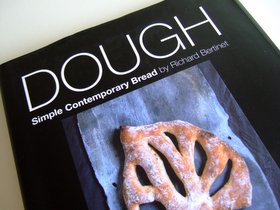
Richard’s book Dough is a million miles away from either the worthy or the fake artisan. This is bread in a lighter tradition, infused with colour and sunshine, the crunch of the baguette, the taste of the olive, and it is hugely inspiring.


He says that English home bread makers don’t know how to make dough. We put in the ingredients, flour, water, salt, yeast, and when the mass is incorrigibly porridgy what do we do? Why, we add more flour. This is quite true, I do it myself.

When a recipe says ‘ knead until the dough cleans itself off the work surface’ I know that my dough will not do that as it is far too sticky. I must have done something wrong, or the recipe is not right, or my flour is different, or, or, or.

Richard showed me how to do it his way. The recipe is not wrong. The mixture is extremely sticky. It would be impossible to knead it in the way I have been used to, with the heel of my hand.

“If you add water to flour it gets sticky” he says. “And your natural reaction to sticky hands is to stop them being sticky, you don’t like the feel of the wet dough on your hands. So you add flour until the stickiness disappears. But the job of the flour is to absorb the water, which changes its consistency and structure, and if you add more flour it can’t do that. Think like a dough hook, it starts off working in the sticky mixture but it’s a dough hook so it doesn’t mind.”


Rule No 1: follow the recipe exactly.

500g strong bread flour

350g water

10g fresh yeast

10g salt


Rub the yeast straight into the flour, do not add it to water.

Add the salt and rub through.

Add the water, keeping back a little in case you don’t need it all.

Now, using a flexible plastic scraper like this, or something similar with rounded edges, incorporate the water into the flour. Turn the bowl with one hand and use the scraper with the other. You will end up with a very sticky mixture. Use the scraper to get the mixture out of the bowl.

You cannot knead this mess in the ordinary way. Indeed, Richard dislikes the word ‘knead’, he says you ‘work’ the dough. “Slide your fingers under it, like a pair of forks, with the thumbs on top; swing the mixture (which is sticky enough to be cohesive, just) upwards and then slap it back down, away from you on to the work surface. Stretch the front of the dough towards you, then lift it back over itself in an arc (to trap the air), still stretching it forwards then sideways and tucking it in around the edges. Keep repeating this sequence.”

I have quoted almost verbatim from his book, but having done it myself I have to tell you that your fingers will be stuck in the dough all the time. There is an almost irresistible urge to clean your hands. Don’t do it! You have to keep going, rocking from back foot to front foot so the tension is eased from your shoulders and you get a whole body motion going. Sort of like baking Tai Chi.

Quite soon the texture of the mess changes into a sticky dough with definite dough-like characteristics, and after a while lo! it actually starts to clean itself off the work surface! That’s the time to stop, clean off what little remains on your fingers with flour, and make the still rather wobbly dough into a ball on a floured surface.


From then on it is pretty much business as usual. You don’t slap the dough about to ‘knock it back’, you stretch and fold and tuck, trying to keep the air bubbles going. I let the dough rise for an hour, proved my loaf for an hour, baked it on a stone as usual, and it came out light and perfect.


The book, with excellent photographs, comes with a DVD. I defy anyone who reads it not to reach for the flour bag.

Dough. Simple Contemporary Bread by Richard Bertinet

Published by Kyle Cathie Limited, 122 Arlington Road, London NW1 7HP

Wednesday, July 05, 2006

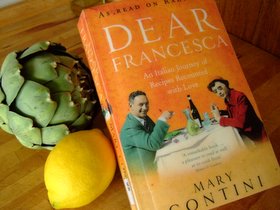
Dear Francesca


On Leith Walk, in Edinburgh, there is a very famous Italian grocery called Valvona & Crolla. Established in 1934, and staffed over the years by members of both the Valvona and Crolla families, it brought authentic Italian foods and flavours to Edinburgh. Scotland has long been a third home to Italians (the second, I think it’s fair to say, being America). When I was a child, growing up in a grey part of Scotland where a red pepper would have been out of place and exotic, the one real taste was the Italian ice cream provided by Toni’s, with the raspberry sauce familiar to anyone who came from north of the border in the sixties. White and icy, it was a world away from the yellow blocks of lard sold by the big conglomerates. Round about that time I went on holiday with my family to Naples and had my first taste of something called ‘tutti frutti’ – I remember it as if it were yesterday.

Both families, the Valvona and the Crolla, came from poor peasant stock in the south of Italy. Emigrating to Scotland in the 1920s in search of a better life they found a supportive community of Italian folk who, prior to the great pizza boom, were providing ice cream and fish suppers to the local Scots, and importing Italian groceries to sell in their shops.

Mary Contini is part of the Crolla family, and this delightful book is written to her daughter, Francesca. She describes the background and history of her own family, their origins in the hill country of Southern Italy, and the recipes they brought with them to this foreign land. Running water was the great gift that Scotland gave in return for the wisdom and culinary lore of a century of womenfolk.

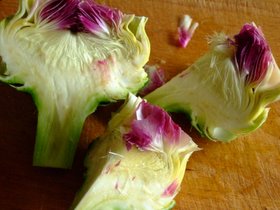
Mary Contini’s observations on food, its quality and history, coupled with a nostalgia for family traditions that have enriched their adopted land, make this a charming book. She includes careful notes on method, one of which - how to prepare artichokes – coincided with the arrival in my house of the tricky vegetable (flower bud actually), and was therefore timely.

Put some cut lemon quarters in a bowl of cold water, get a sharp knife and turn on the cold tap.


Pare down the stalk end nicely, removing some of the tough stalk fibres, and snap off the dark green spiky outer leaves just where they break until the inner pale yellow ones are revealed.


Trim off the top of the artichoke, which is spiky. Inside is revealed a beautiful magenta heart. Rub every cut surface immediately with lemon juice.


Cut the artichoke in quarters and rub with lemon juice. You can see the hairy centre. With a sharp knife cut it away otherwise its like eating a pillow.


Drop the pieces into the acidulated water as you go.


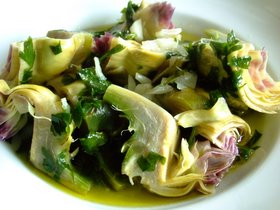
To cook as an hors d’oeuvre:

Put the quarters into a pan with:

1 clove of garlic, peeled and finely chopped

A handful of flat leaved parsley, chopped

About a teaspoon of salt

About 4-5 tbsp olive oil

Same amount of water.

Bring to the boil and then simmer gently until tender.

You might like to add some mint leaves towards the end of the cooking.

Serve warm, and mop up the juices with good bread.


Dear Francesca: An Italian Journey of Recipes Recounted with Love, by Mary Contini

Published by Random House, Ebury Press

Tuesday, July 04, 2006

My date with the dough


Troels Bendix (from Denmark) and Kurt Anderson (from Australia), with the assistance of Ross (from Canada), make some of the best bread in London (England). Breadsetcetera has lately opened a café on Clapham High St, just next to Sainsbury’s, which sells bread to the South London cognoscenti as well as breakfast and lunch. Dinner is on the way. On Sunday mornings you can have a full English, decent coffee, and all the newspapers. And you get to make your own toast in your own toaster and choose from a huge array of really good jams and confitures. Just like being at home, without the washing up.

The bread is all made on an organic sourdough leaven, or biga. No extra baker's yeast is added. Troels has cared for the biga for five years, starting it off in Wandsworth. He says darkly that it didn’t like the move to Clapham. The biga sits in a big vat, a creamy mixture of organic white, wholemeal and rye flours, with water and the magic Wandsworth wild yeast, now tempered with some local interlopers from Clapham. The scent is just slightly sour, but not pronounced. All the bread in the bakery is raised on this leaven. The yeast bacteria thrive in an anaerobic atmosphere, feeding on the simple sugars they derive from the starch in the flour. The by-product of this activity is carbon dioxide, the gas bubbles which raise the dough.

I spent the day in the bakery just round the corner, with Frida (from Sweden) who manages the café and is also a novice like me. Breadsetcetera makes six different kinds of bread regularly, whole grain rye, original three flours, original white, walnut, six seed and olive, plus muffins and flapjacks and cookies. The recipes for the breads are Troels’ own, and he brings the soul and traditions of Denmark to the rye breads in particular.

When we arrived Ross (trained in a Gordon Ramsay kitchen on 18 hour days – now that is a bit of a jaw dropper) had mixed the flours for the recipes and the first dough was curling away in a fifty year old machine. It works slowly and comfortingly and Troels prefers its action to the newer, faster machines. Humming away in the corner it’s like a good friend, solid and dependable. All of the flour is organic and most of it is from Cann Mills, near Shaftesbury in Dorset, milled with a water driven wheel by Michael Stoate.

Salt is added later to the mixture, so as not to inhibit the action of the biga, and some of the dough left over from the previous batch of baking is also added, its sour quality more noticeable after an overnight rest.

The dough comes out of the machine like a duvet coming out of a tumble dryer, and piles in drifts on the stainless steel work surface. It is flowing in its consistency and quite sticky. The proving baskets are generously floured and the dough is cut and weighed. It loses a percentage of its weight through water loss in the baking process, but it must weigh at least the advertised weight – and not too much more because that’s the ‘loss’ in ‘profit and loss’!

Then comes the shaping. Frida and I were completely hopeless at this. An oval loaf is tucked in at the corners and rolled towards you, tucked again and rolled in on itself until it is a tight sausage shape. Round loaves are tucked in and turned a quarter turn, tucked again and turned and then again until the circle is complete; then the dough is flipped over and pushed down and away against the work surface so that the outer skin of the dough tightens into a satiny ball. Frida and I tried. We tried really hard. We were terrible. Every loaf I shaped had to be reshaped by Ross or Troels. I was waiting for the F word and it is a measure of the calming nature of making bread that it never came. But I got good at making rolls, wouldn’t you agree lads?

The dough proves in the coiled cane baskets for about six hours. One of the biggest problems they face in the bakery is the acceleration caused by the heatwave we are in the middle of. They use ice water to mix the dough to retard the proving time. Otherwise tomorrow’s bread is ready yesterday, if you know what I mean.

The proved dough is flipped out of its basket on to a peel, and thence to the oven for twenty five minutes at 250ºC. A fleet of drivers (well, two or three I think!) delivers it fresh to restaurants and shops around London. For the full list see the web site. Most are in the London area, but they are just about to start delivering to Edinburgh!

The café will expand its repertoire presently, with a refit due later in the year and extended opening times. Kurt is planning simple menus favouring tasty produce. Less in the way of sauce and more in the way of source.

If you want to acquire a proving basket you can order a huge variety from the web site. If you are passing the café in Clapham High St drop in for a latte and a chocolate chip cookie and say Hi to Frida and Quentin, and buy a loaf to take home. Try the wholegrain rye – it’s like tasting the entire field.


Thursday, June 22, 2006

First clabber your bonny…

It’s so easy to get sidetracked. I wanted to write about a Somerset cream tea, which would be a homemade scone, with homemade strawberry jam and clotted cream, and a cup of tea. The strawberries are in spate, a big basket was picked a few days ago and the cupboard is now full of twinkling jars of ruby jam. Let’s make some scones.

I noticed that several recipes for scones suggest you use buttermilk. I’ve never done that, but it makes a lot of sense as the acid will encourage the raising agent to work better. We no longer use much buttermilk in this country, although we used to. I know about it mainly from soda bread, and in parts of the country it is easy to get, in other parts of the country impossible. I did find some locally, but just as I was about to start in on the scones I found a site that told me how to make my own buttermilk. The process is known as ‘clabbering’ as what you are aiming to make is ‘clabbered’ milk. Any method called clabbering just begs to be tried. The word ‘clabber’ comes from the Irish word for thickened or the Scots word for mud, whichever you like, and the Irish word for milk is banne (see the invaluable MacBain’s Dictionary). Together they make up the word ‘bonnyclabber’, which is what we know as buttermilk.

You can make buttermilk from scratch with milk that has soured all by itself. If you ever have milk in the fridge that has gone off, with no trace of mould, you can use that, but I didn’t want to hang around that long. In which case you take 6-8 ozs of cultured buttermilk, put it in a scrupulously clean jar and fill up with whole milk. I expect you can do this with skimmed milk too, but I used whole milk.

Leave in a warm place(around 69ºF is best) for 24 hours, by which time the milk should have soured and thickened, or clabbered. Ben Jonson mentions ‘bonnyclapper’ as a drink with beer and buttermilk, but I‘m not sure I like the sound of that – and anyway I don’t know what kind of beer Ben was drinking in the 17th century (but it would be interesting to find out…) Buttermilk keeps for weeks at a time in the fridge.

So, with thoroughly clabbered milk we can get back to the scones.

Buttermilk scones

Preheat oven to 200ºC/400ºF/Gas 6.
225g plain flour
1 level tsp bicarbonate of soda
¼ tsp salt
45g unsalted butter
1 tbsp golden caster sugar
About 185 ml buttermilk

Sift flour, bicarbonate of soda and salt into bowl. Rub in the butter but don’t overwork the mixture, it releases the gluten in the flour which will give a rubbery consistency. Make a well in the centre and add the sugar and enough buttermilk to make a soft dough. Roll out on a floured surface (gently) to a thickness of 1.5cm and use a 5cm cutter to stamp out rounds. Lay on a floured baking sheet and brush tops with milk. Bake for 10 mins until risen and browned.

Eat warm and fresh, with strawberry jam and clotted cream, for a real taste of the West of England in summer.

Tuesday, June 20, 2006

The B word

Susan in Italy was asking how long you can keep preserved lemons once you open the jar. This set me thinking. I remembered reading somewhere about toxins and the word ‘botulism’ was mentioned. BOTULISM? Something about home bottling and canning. I opened the fridge door with my heart beating the soundtrack from Jaws and peered in. There was the jar of home roasted pimentos I had stored in olive oil; there was the jar of olives I made up the other day, with garlic and herbs and olive oil. Hmmm. Out went the pimentos and I am keeping a close eye on the olives.

A little research reveals some reassurance. Although botulism is a very very nasty toxin that attacks the nervous system and causes paralysis it is also extremely rare. Food is contaminated before preservation, and the bacteria germinate and reproduce in anaerobic conditions, producing toxin, which is then ingested. Foil-wrapped baked potatoes, sautéed onions and fermented fish are culprits, plus, let’s be careful here, garlic in oil. I have occasionally seen that garlic in oil ferments, but I didn’t know about the botulism bit.

Food with a high acidity is generally safe because the bacteria cannot live in an environment with a pH lower than 4.6 – lemons, pears and pickles generally have a pH of 2-4 (pears eh?). So we are fairly safe with the lemons it would seem, plus all that salt.

They (preserved lemons) do throw off a sort of sediment, and the lemon pulp particulates in the lemon juice also sink to the bottom of the jar, leaving clear lemon juice and a sort of lemon mud around the base. It does no harm. You can add more lemons and salt, and you need to top up the jar with lemon juice, but otherwise, if you keep the jar in cool, or chilled conditions, there should be no need to worry. As far as I can see they keep for at least six months or for up to a year, depending on who you trust.

It’s the garlic in the olives that worries me, but I think if I add some vinegar that should change the pH… Ah ha! I know! I will add some chopped preserved lemons to the olives - what a very good idea!

Monday, June 19, 2006

Tagine of chicken with preserved lemons and olives


Back in February I made up a jar of preserved lemons. The recipe couldn’t be easier – or look more beautiful when complete.

6 whole unwaxed lemons (about 1 1/2 lbs)
2 1/2 cups lemon juice
6 tablespoons coarse sea salt
1 tablespoon black peppercorns
1 quart jar

Do try to get unwaxed lemons because it can be very difficult to remove the wax otherwise. Cut the lemons lengthwise into six sections, keeping them attached at the stem, so that the lemon will hold together. Pack 1 tablespoon of salt inside of each lemon. Place lemons and black peppercorns into a sterilized jar and completely fill with lemon juice. Seal the jar and leave to mature for 4 weeks in refrigerator. Rinse lemons before using.

(What I didn’t realise was how much lemon juice you need – half way through I had to dash off for more lemons to make juice to fill the jar!)

The jar has been sitting in the dark of a cool cupboard for a number of weeks now and trying to attract my attention. Eventually it succeeded.

Tagine of chicken with preserved lemons and olives

This recipe is from Claudia Roden’s book Arabesque and is also available on BBC Food. I have always treasured her cookery books and my copy of A Book of Middle Eastern Food is completely dog eared and stained. This was the book from which I learned to make couscous, pitta bread, hummus and baklava, and heard about rosewater and Imam Bayildi for the first time. She included poetry and wisdom from the East and wrote with an exotic passion that struck my youthful heart and made my mouth water.

The original recipe for this tagine includes artichokes and I would think that would be terrific, if I had any artichokes!

Ingredients

3 tbsp extra virgin olive oil 2 onions, finely chopped

2-3 cloves garlic, crushed

½ tsp crushed saffron threads or saffron powder

¼-½ tsp ground ginger

1 chicken, jointed

salt and freshly ground black pepper

½ lemon, juice only

2 tbsp chopped coriander

2 tbsp chopped parsley

2 small preserved lemons, peel only

12-16 green or violet olives, either stoned or left whole

Method

1. In a wide casserole or heavy-bottomed pan that will fit the chicken pieces in one layer, heat the oil and add the onions. Sauté, stirring over a low heat, until softened, then stir in the garlic, saffron and ginger.

2. Add the chicken pieces, season with freshly ground black pepper, and pour in about 300ml/10fl oz of water. Simmer, covered, turning the pieces over a few times and adding a little more water if it becomes too dry.

3. Lift out the breasts after 20 minutes and set aside. Continue to cook the remaining pieces for another 25 minutes, then return the breasts to the pan.

4. Stir in the lemon juice, coriander, parsley, preserved lemon peel and olives. Cook slowly until the sauce reduces a little. Check for seasoning – the preserved lemons may have given all the saltiness required. Serve with the olives and lemon peel on top of the meat.

This is a wonderful dish, fragrant and pungent at the same time, and incredibly easy to make. I served it with plain rice but I considered couscous with apricots. On reflection it really doesn’t need any other distractions; the lemon and coriander and parsley and garlic do a dervish dance in your mouth that is quite delirious enough.

Friday, June 16, 2006

P.Y.O.

Yippee! This is the day I’ve been waiting for for weeks, this is the day the PYO opens.

The best thing would be an allotment, but my parish council doesn’t have any allotments, so the next best thing is the Pick Your Own fruit and vegetable farm. Due to our crazy weather it has opened a little late this season, and today was my first day there.

Tom Phippen’s farm, at Chew Magna, is run by Tom (son of the original Tom), and his wife Jean. High above Chew Lake, it has one of the best views in the county and an atmosphere of complete peace and tranquillity. The season starts with strawberries – grown at table top height for ease of picking – and gooseberries, and continues through raspberries, tayberries, blackcurrants, redcurrants, broad beans, peas etc etc. It is the next best thing to growing them yourself – actually in many ways it is much better than growing them yourself because someone else has done all the hard work!

Gooseberries are suddenly terribly fashionable and according to Jean the crop will be completely picked in ten days. It used to be that you couldn’t give gooseberries away, but now the goosegog has become hip, the cool green berries rarely seen in supermarkets and having a short season. They are easy to pick, although the bushes are thorny, and, unlike the other summer fruits, not as tempting to gorge yourself on whilst picking.

Top and tail them, and then put to stew gently with a little water and quite a lot of sugar. Sometimes I add elderflower cordial for an extra kick. This will be my breakfast for the next few days, with some greek yoghurt.

They make the best fool in the world, swirled with custard, or, even more decadently, whipped cream. Or try as a sauce for mackerel, the fish slashed and grilled over the barbeque.

Tom Phippen’s farm, Chew Magna 01275 332397 – phone for directions (Tom and Jean, see left)

Wednesday, June 14, 2006

Thanks to the Sisterhood of the Stove

A big thank you to everyone who sympathised and offered advice about the no image problem. Blogger is still behaving in a very white and shaky manner and the doctors are muttering at the end of the bed, but I loaded up Firefox and the little sneaky creature found a way through for my pictures. Below is the post I started to try and send over a week ago.

It was quite strange to be blogless for these few days. Like a missing limb.

Wednesday, June 07, 2006

Slow Food, Sauncy Chops


The Slow Food movement was born in Italy in 1986, as a response to fast food and ‘fast life’. It now involves over 80,000 people in 104 countries around the world. It celebrates differences in flavours, artisanal food production and sustainable approaches to fishing and farming.

Once a month there is a Slow Food market in Bristol, the first of its kind in the UK. As the sun eventually came out at the start of June it shone down on a vibrant bunch of stallholders and producers. Fresh garlic and tomatoes from the Isle of Wight, artisan bread, great cider and apple juice, herbs, honey and organic meat.

I was delighted to meet Andrew Moore from Th
e Thoroughly Wild Meat Co, Bratton House, Bratton Seymour, Wincanton BA9 8DA (01963 824788). He grazes his lambs on the Somerset salt marshes, one of only a handful of farmers who raise their meat this way. The sheep feed on wild grasses and the natural antibacterial qualities of the salt water dramatically reduce the need to douse the sheep with chemicals. Lambs grazed in the Normandy salt marshes command premium prices, but in England we are only just beginning to catch on. The Welsh too produce salt marsh lamb, some of which made its way to the final of BBC TV’s Great British Menu series.

Andrew is passionate and enthusiastic, and patient with enquiries. He waxed lyrical about his salt marsh mutton chops, so lyrical that I had to try them. They were at least two and a half
inches thick and, having been hung for at least seven days, a mature dark red. As they sat bathing in a little olive oil and strewn with rosemary,
waiting while I put the barbeque together ("this will only take a minute...")
and then for it to come up to temperature, my mother said “What sauncy looking chops!” I think this means attractive, good looking, but I can’t find it in any dictionary, so I guess it’s a Northern
Ireland expression. But fitting I think. Sauncy chops.

And if sauncy can also mean absolutely unforgettably delicious then they are definitely sauncy. If I could eat chops like this every day I would, and as this is probably exactly what the Victorians, and Dr Johnson and co were eating, this is probably why the mutton chop was as popular then as it was. As a rule I’m not crazy about lamb – often it is rather pallid and nasty, but this is like Beethoven after a jingle – a real flavour, with depth and richness, and the robust texture of an animal that has not been intensively reared. Andrew was talking to me about the soil qualities on his land, and I think I will have to visit and investigate a bit further. Mmmmm, and he also farms roe deer for venison…
You can order from him at sales@thoroughlywildmeat.co.uk

Sunday, June 04, 2006

My beautiful loaf!


I started a sourdough leaven a few weeks ago and it has been bubbling along in the kitchen ever since. I kept it in the fridge for a few days and then decided it was better out on the worktop. Most days it gets a spoonful or two of flour, after which it froths up the jar and then subsides, having had its lunch. On bread making days I take out what I need, empty the remainder into a jug, and top up with water. The jar gets rinsed out carefully and the leaven goes back into the clean jar, with the addition of enough flour to make a thick paste.

I’m learning how to use the leaven; it sits there, bubbling away until it is needed, and it is available at a moment’s notice. Whether it is bread , or focaccia, or even pancakes, it is on hand.

I still hold my breath as the dough flips on to the bakestone – it seems to me to be so soft, almost flowing in its consistency, I can scarcely believe it will hold together. I am experimenting with adding more flour, but I’m so delighted with the bread that I’m reluctant to mess it up! The structure is just right, with a barely detectable sourness and wonderful keeping qualities.

This is the most recent loaf, made with organic flour from Stoates at Cann Mills, Dorset – thank you Michael! It makes bread with a rich creamy crumb; the crust was thin and crisp and the taste was full and rounded.

I think this will be the last of the sourdough posts for a while – until I experiment with something new.

Friday, June 02, 2006

Borrowed caponata

When I wrote in a recent post about a wonderful plate of antipasto that I ate at Carluccio's in London I had a note from Susan in Italy to tell me that the 'aubergine chutney thing' I enjoyed so much was probably caponata. In the end I don't think it was, because it didn't have tomato in it, but I have been introduced to caponata and now I think I could live on it. So a huge thank you to Susan, and here is how to make this fantastic sweet and sour Sicilian dish:

I have adapted this recipe, which comes from Kake's (Vegan) Cookery Site, and Kake adapted it from a recipe by Sheldon (rec.food.cooking) found at Epicurious, and Sheldon found it in the July 1991 issue of Gourmet Magazine, which goes to show that if you are going to borrow recipes make sure you borrow from the very best! It also features in Elizabeth David's Italian Food in which she describes it as 'An interesting dish. Try it in half quantities.' Her recipe (keeping up the borrowing tradition) comes from Edmond Richardin's L'Art du Bien Manger and he claims that it came from the chef of the German Ambassador in Rome.

I have omitted anchovies (Richardin) and green olives (Sheldon) because I didn't happen to have any, and used sherry vinegar because I did happen to have some of that and I didn't have any red wine vinegar. The basic ingredients remain the same.

Olive oil
1 aubergine diced, salted and left to drain for half an hour, then rinsed and patted dry.
1/2 medium onion, chopped
1/2 stick celery, chopped
2 tbsp capers, drained
4 tbsp sherry vinegar
2 tbsp demerara sugar
2 tbsp sultanas/golden raisins
2 tbsp pine nuts
1 can chopped tomatoes
2 tbsp flat leaf parsley leaves, chopped

Cook the aubergine in oil until soft, but still retaining a little firmness. Transfer to a bowl.
Clean pan if necessary. Add more oil to pan and cook onion and celery until onion is soft but celery retains a little bite.
Add capers, vinegar, sugar, raisins, pine nuts and tomatoes and cook through. Let the liquid from the tomatoes evaporate off.
Add aubergines and parsley and stir through. Transfer to a bowl to cool, overnight if possible. Check for seasoning and serve.

Actually I couldn't wait for it to cool overnight. I ate it warm. I ate it for lunch the next day. I would have eaten it for breakfast if I had remembered.

This is a dish that you make according to your taste, and whatever you happen to have available. Next time I will try it with anchovies, and perhaps some black olives, although the recipe says green. I think it looks beautiful.
 
Creative Commons License
This work is licensed under a Creative Commons Attribution-NonCommercial-NoDerivs 2.5 License.