Tuesday, October 31, 2006

All Hallows Eve


To be perfectly honest I hadn't really thought about writing a post for Halloween, what with the kid being in Barcelona. Then I saw Asha's site - and I thought maybe I should. Then I thought, Asha's site is so damn fabulous that I will just tell everyone to go look at it, and wish they were a kid themselves again. Spook yourselves silly!


Sunday, October 29, 2006

The best cooking apple in the WORLD!


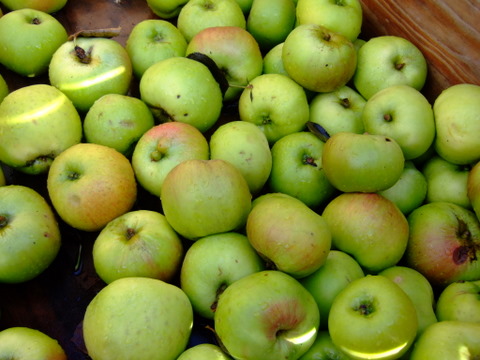
This has been a great year for apples. Trees everywhere are laden with them and they litter the sides of the road in great golden heaps. I can never understand why the British just leave them there to rot – anywhere else in Europe this bounty would be snatched up and turned into something delicious.

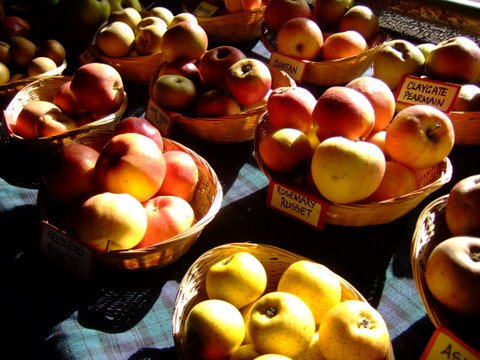
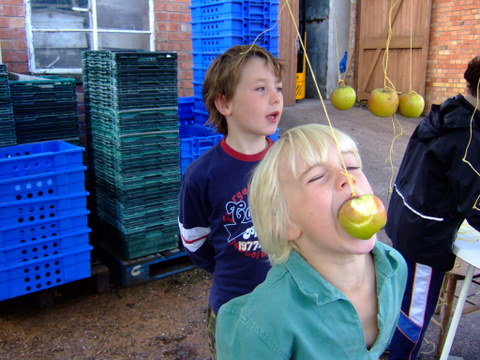
Common Ground is a charity working to encourage people to value and enjoy their own familiar surroundings. As part of the Local Distinctiveness Campaign, Common Ground publishes books and leaflets about apples and co-ordinates National Apple Day in October.


It was great to see the enthusiasm with which people turned up at local orchards, bringing old varieties for identification, and admiring the number of apple varieties still being grown commercially in Somerset.

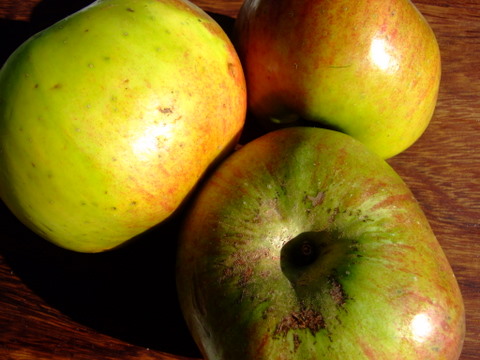
The tree in my garden has been producing huge fruits, with a rosy blush and red striations, which turned out to be a Bramley clone. Novice that I am, I thought Bramleys were always green and I got what can only be described as an old-fashioned look from the apple expert at the orchard.

The food lover’s romance with Bramley apples seems to be an on-off affair. There are times when nothing but an eating apple will do because it retains its shape when cooked, and there are times, and now seems to be one of them, when the frothy, foaming, explosive qualities of the Bramley are suddenly the flavour of the month.

The UK is the only country that grows apples especially for cooking. More than 140,000 tonnes (£78M) of Bramley apples are sold annually, with the fresh market (65%) still dominating supplies to the consumer.They contain high levels of malic acid and so remain tart and "appley" in flavour when cooked, unlike eating apples which tend to lose their natural flavour during cooking. This type of apple also contains more vitamin C than other varieties.

The history of Malus domestica - ‘Bramley's Seedling’ – is documented in a pub called The Bramley Apple in Southwell, Nottinghamshire.

In the garden of a nearby cottage in the year 1805, the lady of the house sat eating an apple. She enjoyed it so much that she set two or three pips in a plant pot. One seedling flourished and was planted in the garden. So began the life of an apple tree of great historical interest.

By the time Matthew Bramley purchased the cottage, in 1846, the tree was bearing a good crop of apples. One day, Henry Merryweather met a gardener carrying a basket of these apples. Asked where he had got them the gardener replied, “It is the Bramley’s apple; and a very fine one too.” Henry went to see Matthew who said that he had named the apple Bramley’s Seedling and agreed that Henry might take what grafts he liked.

The apple first appeared to have been exhibited in 1876 at the Royal Horticultural Society’s Fruit Committee, where it was highly commended. While it may have been possible to count the apples that grew on that first tree, nobody knows the number of trees that have originated from the apple a lady of Southwell ate in the year of Trafalgar.”

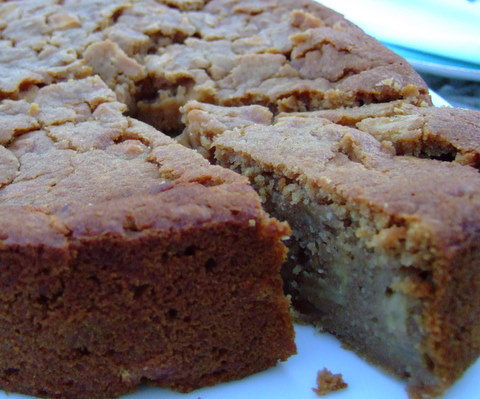
So the Bramley is two hundred years old, and still the mainstay of apple pies throughout the country. In Somerset we use them to make a cake, Somerset Apple Cake. Of all the various recipes I think this one is the best:

Ingredients

For the cake:
225g/8oz Bramley apples, peeled, cored and diced
½ tsp ground cinnamon
25g/1oz demerara sugar
350g/12oz self raising flour
1 tsp baking powder
150g/5oz butter or margarine
150-170g/5-6oz caster sugar
2 eggs
120ml/8 tbsp milk

For the topping:
25g/1oz demerara sugar
pinch ground cinnamon

Method

1. Preheat oven to 180C/350F/Gas 4.

2. Line 20cm/8in cake tin with baking parchment or greased greaseproof paper.

3. Blend cinnamon and demerara sugar and coat diced apple with mixture.

4. Sift flour and baking powder into mixing bowl.

5. Rub in butter or margarine, add caster sugar, beaten eggs, milk and apples.

6. Blend thoroughly then beat with a wooden spoon.

7. Spoon into a cake tin, spread flat on top and sprinkle with sugar and cinnamon.

8. Bake for approximately 1¼hours/75 minutes, or until firm to touch.

9. If the cake is becoming too brown on top, reduce heat to 160C/325F/Gas 3 after 1 hour.

Tuesday, October 17, 2006

World Bread Day


I fear I have not been paying attention. I completely failed to notice that yesterday was World Bread Day. So I thought I would try and do some catching up. Hmmm. Easier said than done. The fresh yeast in the fridge was a little the worse for wear, but hey, what have we here? My goodness, it’s a Bread-in-a-Box kit.

Courtesy of IKEA, where the weird food is half the fun, this is a box containing the ingredients for what looks like my kind of wholegrain rye loaf. They include wheat flakes, rye flakes, various seeds, malt and dried yeast. And of course a couple of other things that may or may not be doubtful but I don’t have them in my larder. However I put my faith in IKEA.

Opening a Tetra Pak is always a bit of a challenge, but I did that successfully and poured in the requisite 20 ozs of water. That seemed rather a lot to me. Could they have meant to say fluid ozs? Do you know, I rather think they did. So now I have rye soup. I pour it into a big bowl and add about six or eight handfuls of wholemeal flour until it is the consistency of thick mud. The original instructions say to shake the contents for 45 seconds and empty the dough into the tin. Would that have made what I know as dough? Or would it have made a thick mud pie? Trying to deduct the extra water and compensate with extra flour is difficult when you don’t know how doughy the dough was supposed to be. I end up with not one but two tins full to the brim with mud pie.

Now the instructions say wait 45 mins for it to rise. But I have doubled the quantity of water, flour, dough and therefore halved the quantity of yeast so that may be 90 mins. If the dough rises at all it will dribble over the tops of the tins. I spend the morning running anxiously into the kitchen every ten minutes to see what it happening. After half an hour – absolutely nothing.

I read the instructions again and notice that the baking time, at 200ÂșC, is 60 mins. 60 mins – for a little tin like this? Maybe that’s to allow all the water time to evaporate. I wish I knew a bit more about chemistry. 45 secs shaking, no kneading. How is that going to make the whatsit molecules bind together and form gluten? If the raising agent was bicarbonate of soda, maybe. But it’s yeast. I’m baffled.

Another scoot into the kitchen to peer at the tins. Can’t see any difference. Not a micron.

Maybe the yeast has turned up its toes. What does the sell-by date say? 290607. So, still got a while to go then.

I start to bargain with myself –

“I’ll leave it for another half an hour and that’s tops. Then it goes in the oven. If it ends up as hot muesli I can have it for breakfast.”

“But suppose it boils, and billows up, and explodes all over the oven which I have just, as it happens, cleaned?”

(Exploding muesli – there’s a thought…)

“Surely the fierce heat will make a crust, and the mixture will be contained within it, so the worst that will happen is it will be a very soggy loaf.”

(Maybe the birds will like it…)

"But I want it to look like the picture on the packet. Ohhhh, bratwurst…"

The half an hour is up. No movement upwards, sideways, any way at all from the muddy mixture. Into the oven with you then.

(I wonder if this tale will have a happy ending?)

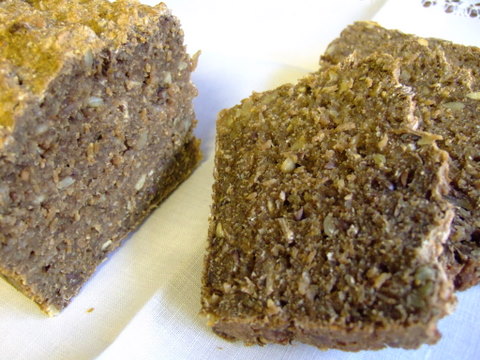
Well, not really. Looks like a brick, feels like a brick and tastes like – actually it tastes not bad, pretty stodgy and not enough salt but, if sliced thinly enough it might be good with smoked salmon…

Oh for goodness sake, who am I kidding?

Monday, October 16, 2006

Absolute Winners!


I like cheese. Or at least, I like cheese that tastes of something. One of my memories of France when I was on an early exchange is of the local cheese – Brie de Melun – and the way it was displayed in the shop. It sat on a little rattan or cane mat, fairly oozing. At dinner that night the smell was pungent. With a sheltered upbringing I always thought of rotting cauliflower, and after the steaming cauldron of ox’s heart that we had just been served I wondered about the wisdom of this runaway cheese. After a childhood of Dairylea triangles it was a bit of a challenge. But smeared on a crust of good French bread and in the mouth – what an explosion. Al dente rind, a slight whiff of ammonia in the nostrils, and the creamy curd, liquid in the centre…I can still taste it in my memory.

French cheese came to English supermarkets on the backs of English holidaymakers. Little cane boxes of Camembert which got deep fried and served with cranberry sauce for a while, strangely. And dreadful white chalky triangles that were specially made to taste of absolutely nothing. Then, as if this was not insult enough to Gallic culture, we ourselves started to make something we had the nerve to call Brie. I am despondent to say we attach the good name of Somerset to it, and call it Somerset Brie. It’s like eating a blotting paper sandwich filled with Dunlopillo.

So I stayed well away from English people purporting to make French cheese – leave it to the experts I thought.


And THEN I went to the Great British Cheese Festival in Cheltenham the other day. O frabjous day, kalloo, kallay! Simon and Carol Weaver’s organic farm is in the Cotswolds, halfway between Lower Slaughter and Lower Swell (really) and they make really wonderful, wonderful Brie. Brie lovers should moan with pleasure. I tried the plain Brie there and walked, well, skipped, off with a whole Blue Brie. There’s another one too with a mix of organic herbs. I didn’t know we could do this, and my heart is bursting with pride! The cheeses are eye-catchingly packaged, in classy white with a black and gold band.

And then, as luck would have it, there were quinces in the market. Fragrant, and with a
woolly fluff that wipes off, they seem to me to speak of the Middle Ages. Their golden warmth is like the last rays of summer, before we settle down to the russets and conker colours of autumn. Peel them and chop, with a very sharp knife because they are extremely firm, and put in acidulated water. And as I had wonderful cheese I made membrillo to eat with it.

Quince Paste (Membrillo)
Ingredients
2lb quince, peeled, cored and chopped
1 tsp cinammon

½ tsp salt

1.5lb sugar

Method
Place the chopped quince and cinnamon in a preserving pan or large, wide stainless steel or lined aluminium saucepan.

Add the salt and pour in enough water to cover the chopped quince.

Bring to the boil, reduce the heat and simmer until t
he quince is tender.
In a food processor or blender process the quince mixture until completely smooth.
Return the quince puree to the pan and gradually add the sugar. Cook stirring over a low heat until the mixture thickens into a sticky paste and takes on a caramel colour.
Pour the quince paste into a lightly greased tray and let it cool and set.

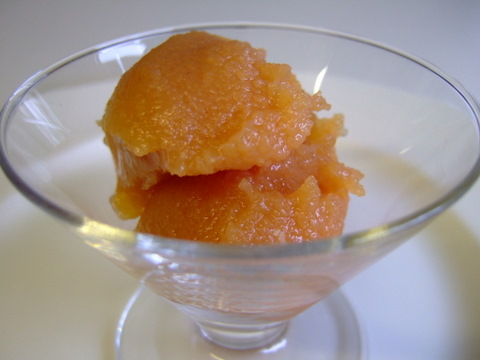
I have left out timings because mine seemed to take much much longer than the original recipe. I didn’t quite have the courage to keep stirring until the colour was the rich dark caramel I was looking for, what with knowing it was about to burn on the bottom of the pan and having it spatter continually up my arm! So mine is a delicious rosy terracotta colour, not solid, but excellent all the same.

Saturday, October 14, 2006

Barcelona for Beginners


I'm absolutely delighted to report the launch of Barcelona for Beginners, written by my wonderful daughter, currently residing in one of the coolest cities in Europe. Welcome to the blogerati, Sienna!

Sunday, October 01, 2006

A Tale of 12 Kitchens


Sometimes I look at the books about food and cooking that fill my shelves, and, knowing that they represent quite a small percentage of the vast number of volumes that have passed through my hands I ask myself why I chose to keep these few. Some, it is true, are recipe books, in the sense of being a list of recipes, ingredients, methods, divided into chapters on soups, meats, desserts etc. But in many the recipes are almost subservient to wonderful and passionate writing about food and colour and love. The secret inner adventure of planning a meal; the breath-quickening sashay through the aisles, eyes darting, mouth dry with hopeful anticipation; the moment when, cleaver in hand, the first downstroke of the preparation begins, like the start of a symphony. The whir and buzz and sizzle and blast of the cooking process that take me to a happy place of concentration where I only realise how long I have been standing on my feet when they start to protest. It’s lovely that other people enjoy what I have cooked; it’s wonderful to have that warm feeling of friends around a table with clinking glasses. I just hope they have got half as much out it as me, and the books that conjure these feelings are the ones I keep.

Jake Tilson’s book A Tale of 12 Kitchens. Family Cooking in Four Countries stokes the fires of an intense personal cooking experience like nothing I have read for ages. It is a book I didn’t want to reach the end of. Everything that we imagine in our culinary hearts is in this book. Everything that we remember from our youth, from our travels, from the clippings we hoard and the postcards friends send us, from celebrations, mistakes and triumphs, from the untried and the totally familiar.

Tilson is an artist and graphic designer; his wife is a ceramicist; his parents are artists. His life has been teeth-grindingly jealousy inducing – childhood surrounded by the artistic cream of a generation, a rambling country house with home produced beer and later regular trips to Tuscany where his parents settled. Sojourns in New York as a student and with his family, and the wild north of Scotland where his in-laws farm. Trips to the American desert with his wife and young daughter. The bare facts would be enough to fill a book, but everywhere he has been Tilson has collected food experiences and memories, recipes and packaging, memorabilia and produce.

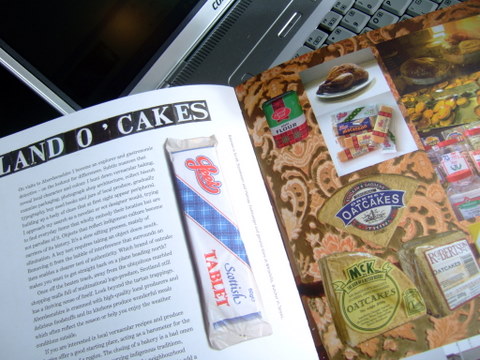
In Italy he gathers the wild herbs of the maquis to cook with a duck, researches his recipes from a library of Italian cookbooks, makes fig conserves and lugs plane loads of local ingredients back to England. (In fact this latter, the importing of lavender from Italy, oatcakes from Aberdeen, chiles from Mexico, is a preoccupation. The two containers of vintage kitchen utensils from a shop in the Californian desert illustrate the obsession.)

In New York he celebrates the city and its amazing breakfasts in an homage that should have Woody Allen slapping his forehead. In Scotland the bakery culture is elevated to great art and the inclement tendency of the weather becomes a natural ingredient. In LA and Palm Springs we learn more about chiles than we are ever likely to need to know, and the Peckham area of London becomes a multicultural Aladdin’s gastrocave .

This book is a feast for the memory and the imagination and also for the eyes. Generously and impeccably illustrated by the author, even the typefaces and fonts are his own. (Some people give their publishers a manuscript; Tilson gave his publishers a Quark file.) And while the memories are undeniably his own, some of mine and some of yours are in there too somehow.

A Tale of 12 Kitchens. Family Cooking in Four Countries by Jake Tilson

Published by Weidenfeld & Nicolson

Thursday, September 28, 2006

Visit Bev


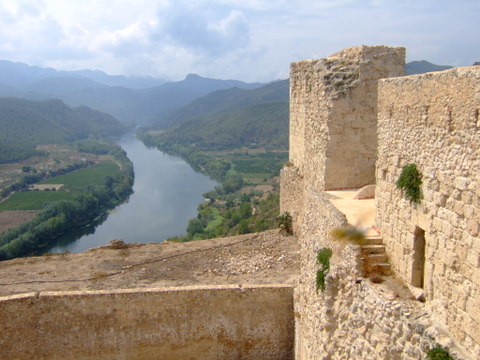
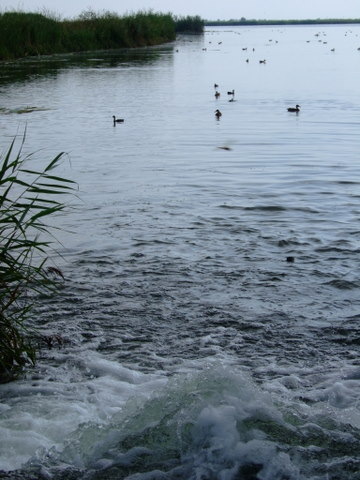
Inland from Tarragona you head left for the Priorat and right for the Penedes. The coast is filled with big white hotels and big red Brits, although, to be fair, the Costa Dorada has a much more upmarket feel than some parts of Spain. However, once away from the tourist haunts accommodation becomes a little harder to find. There are apartments and houses to rent that can be found on the internet, but to be honest I found that many of the enquiries I made met with silence, even though I did write in Spanish. I was, therefore, delighted to discover Mike and Bev Powell, who were the first English people in Mora D'Ebre and have acommodation to let. Mora D'Ebre itself is a busy little place with an old part of town near the river. We stayed in Mike and Bev's house there and it was quiet and well set out, with good accommodation for up to four people in two bedrooms, and a sofa bed as well. Mora D'Ebre is in a very good location for the wine regions, for amazing castles and views (see above) and for the coast, as well as the extraordinary delta region of the Ebre river, where the main crop is rice.

If you are planning a trip do contact Bev at
www.riverebrohomes.com

Saturday, September 16, 2006

Casteis


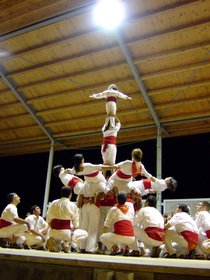
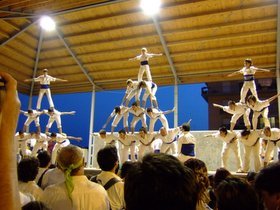
We drove around vertiginous hairpin bends with sheer drops into deep valleys and found ourselves in a mountain fastness in the north of the Penedes region in Catalonia. Someone had told us that there was a gathering of ‘casteis’ teams. As the dusk fell they arrived, teams of men and women and children from towns and villages all over the region, there to celebrate the tenth anniversary of the local team.

Building a tower several storeys high from human beings is a pastime unique to Catalonia. On Sunday mornings people assemble in the main squares of the towns and construct these intricate columns, clinging on to each other and swaying dangerously. It is a dangerous sport. People fall and hurt themselves.

In the 1920s someone went to Czechoslovakia and came back with a Czech form of gymnastics that seemed to fit in with the tower building, and the Falcons of Catalonia were born.

It starts on a command from the master builder and the team lines up in their white trousers and coloured sashes. Little kids mill around, taking in the audience and the bright lights.


At the base of the structure are the strongest men of the team; on top of this base the layers build up, both men and women, then the young people, and finally, heart stoppingly, the very youngest of all race up the scaffolding of bodies and raise an arm in a triumphal salute. The child at the top of this pyramid is the same one as above – she could not have been more than five or six years old. My jaw dropped.

By this time the mass of bodies may be six or seven layers high, and teetering frighteningly. Sometimes it breaks away, leaving just a tower of people standing on each others shoulders, maybe six of them one on top of the other.


Other towers are built from a mass of bodies and hands and shoulders, with the non-participants leaning in towards the base, steadying the tower like flying buttresses.

There's something throat tightening about a community that quite literally supports itself on the backs of others, with its tiniest members fearless and trusting at its apex.

And then it’s over, the fireworks start, shoot heavenwards and tumble back, and everyone goes home.

Friday, September 15, 2006

D.O.Q


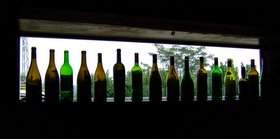
I feel as if I’ve just been let into the most wonderful secret. I have spent the last week in the wine producing areas of Priorat and Montsant in Catalonia in Spain.

All I knew about Spanish wine amounted to two words, Rioja and Cava. Then I read that Robert Parker had awarded wines from the Priorat marks in the high nineties and, as I was going that way anyway, it seemed like too good a chance to miss.

I’m not even going to pretend that I know a lot about wine. But it’s always interesting to see what your palate tells you about something you know nothing about.

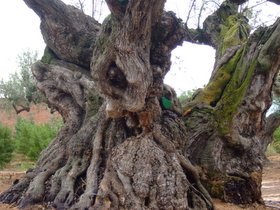
The Priorat is a small DOQ region, surrounded by the crescent of the larger DO region of Montsant. Both are inland from Tarragona, south of Barcelona. The Priorat, which gets its name from the priory or monastery of the Carthusians at Scala Dei in the north of the region, is a land of harsh and beautiful mountain landscapes, of vines and olive trees, and a slate soil called ‘licorello’. Montsant has a greater soil diversity and its vines are allowed to produce a greater quantity of grapes. In Priorat sometimes only one kilo per vine is permitted, concentrating the flavour into powerful wines. The grapes are the traditional cariñena and garnacha, but now with quantities of syrah and merlot for structure. Anyone interested in learning more will find this article by Gerry Dawes extremely interesting.

The centre of Priorat production is the hilltop village of Gratallops, and, as luck would have it, there is a really good restaurant there, Los Irreductibles.

The kitchen is presided over by Ricardo Signore and the influence of Ferran Adria is evident throughout the menu. What is also great about this restaurant is that, firstly, there is no choice, you get what Ricardo has decided to cook. And secondly you can ask him to let you drink wine by the glass instead of having to order a bottle. So you get a glass of what he thinks will go best with what he has decided to cook. And when that is monkfish with fig confiture, or fillet of beef with foie gras and coffee, it is good to have someone else do the choosing! I think my favourite dish was a rich chocolate dessert with a coconut cream sauce and curry foam. The scent of the curry with the chocolate was wonderful.

Wine business is done in Falset, a busy little town on the main road to Reus. Wine people gather in the restaurants of El Cairat, El Celler de L’Aspic, Hostal de Sport and Mas Trucafort for Catalan specialities and more great wine.

South of Falset is one of the Montsant co-operatives at Els Guiamets, where the young winemaker, Eugenia Guasch, speaks excellent English and will show you round her Celler. The grapes were coming in the door in trailer loads as we talked. Montsant is a very young DO which already shows great promise, although it does not have the grandness, or the punch, of its stately neighbour in Priorat. The winemakers are young and enthusiastic and, typically, Eugenia’s top red wine, Isis, has a label designed by the current architect of the Sagrada Familia in Barcelona, and a strangely shaped bottle with a sloping back.

Most of the wine in both regions is red; the Priorat produces wines with tremendous concentration and power, redolent of wild black fruits, licorice and herbs. And they command high prices. The wines of Alvaro Palacios were on the restaurant menus for over €300, and fetch astronomical prices elsewhere. A big discussion is going on about the use of oak, and most of the good producers are cutting down on it. One of the ways they temper the new oak is by using it for their second wines, and also for the small amount of white wine produced. This gives the ordinary white wines a strong oaky taste, ok with food but a bit much without!

To the north of the region the mountains rise steeply; to the south the river Ebro marks the western edge and over to the east the region of the Penedes starts, with its massive Cava production.

And that’s where the blog went next, not to drink Cava, but to see something quite unique…

Monday, September 04, 2006

The Oxford Symposium


This last weekend saw the twenty-fifth Oxford Symposium on Food & Cookery take place in the elegantly functional surroundings of St Catherine’s College Oxford. Designed, down to the door knobs and the fish in the ponds, by Arne Jacobsen in 1963 it is a calm yet surprising environment and it looks as if the Symposium will settle in here for the foreseeable future.

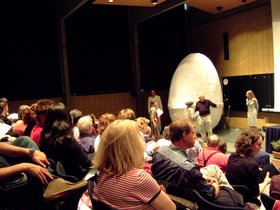
The topic under discussion this year was The Egg; star of the show was undoubtedly Prof Hervé This whose presentation on Molecular Gastronomy, complete with props of potentially explosive egg whites, brought the house down. I have never seen spread sheets excite so much delight. Wild hair, escaping shirt tails, flailing arms, comedy accent, we were entranced.

Papers were presented in parallel sessions so you had to make hard choices. I thought the participants would be an earnest and academic lot, intimidating as an assembly. They are serious, but not earnest, amateurs in the best sense of the word, and there were some fine presentations. Among those I saw I loved ‘Creating with Arctic Eggs’ given by Zona Spray Starks, about the fish eggs of the Arctic where she grew up. It was fascinating and really quite disturbing. I arrived at Michelle Toratani’s presentation on raw eggs just as she got to the word ‘mucilaginous’ and was sorry I missed what went before. Phyllis Thompson Reid gave a clever and sprightly paper - “the Ultimate in Cookery”: The SoufflĂ©’s Rise and Feminism’s Second Wave – to an audience that converted the session into a vibrant discussion on Julia Child.

The food was excellent with menus and recipes by Caroline Conran and Anissa Helou. Egg oriented, but not so you would really notice!

Carolin Young has a wonderful project to bring Salvador Dali’s idea for a giant hard boiled egg to fruition. Participants got into Blue Peter mode and stayed up half the night to make a papier machĂ© model of the mould for this creation, which it is reckoned will take 153,400 eggs to make. The idea is to separate the eggs and whites and make a giant hard boiled egg. I had a really interesting discussion with a scientist about whether it would actually stand up once out of the mould, or whether it would collapse under its own weight. I think this pondering is an extension of the artistic idea. Prof This has however offered to provide a spray-on calcified surface to offer protection. This we have to see!

The people who came to the Symposium were an absolute delight. Please take a look at Jake Tilson’s book 'A Tale of 12 Kitchens' ( Weidenfeld & Nicolson) because you will love it. Not only did he write it, he designed the whole thing too, down to an original typeface. It is colourful and intriguing and begs to be read. I will be reviewing it in a later post.

Jeffery Steingarten was there and although my heart was a-flutter I did go and chat to him. Actually I went down on one knee.

So if you come next year you too will get to prop up the bar with Raymond Sokolov! Please come. All the people that write to me on this blog would love the Symposium. It’s open to all, the place is a gem, so just boogie on down to Oxford in 2007.

Wednesday, July 26, 2006

Wish you were here

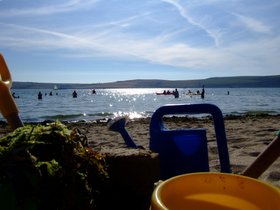
The Blog has taken its bucket and spade to Cornwall...


2006 is the centenary of the birth of John Betjeman, poet. He was a popular poet, in the sense that the people understood and loved him and he loved Cornwall, particularly the little church of St Enodoc, above the wonderful beach at Daymer, near Rock,(see above).

St Enodoc's Church was rescued in the nineteenth century from the sand that had engulfed it - in order to celebrate its consecration the vicar had to be lowered through a skylight - and now stands in the middle of a rather posh golf course.
" A mile of sunny, empty sand away,
A mile of shallow pools and lugworm casts.

Safe, faint and surfy, laps the lowest tide."


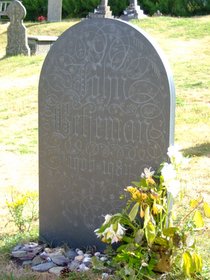
Betjeman is buried in its tiny churchyard, his ornate gravestone near the lych gate with its lead topped stone the shape of a coffin, a pause for the funeral procession to get in line.


I'm enjoying freshly boiled lobster and great fish dishes, but nobody should leave Cornwall without saffron cake. The Cornis
h people traded their tin with the Phoenicians for saffron, and the traditional saffron cake - a fruited tea bread heavy with the yellow spice - is available everywhere. I didn't make it, but I am certainly eating a lot of it!


People had left stones on Betjeman's grave, and I did too, whispering "This is from Joan Hunter Dunn" as I did so. I think saffron cake would have been her sort of thing, if she could have got it in Aldershot.

A Subaltern's love-song

Miss J. Hunter Dunn, Miss J. Hunter Dunn,
Furnish'd and burnish'd by Aldershot sun,
What strenuous singles we played after tea,

We in the tournament-you against me!

Love-thirty, love-forty, oh! weakness of joy,
The speed of a swallow, the grace of a boy,
With carefullest carelessness, gaily you won,
I am weak from your loveliness, Joan Hunter Dunn.

Miss Joan Hunter Dunn, Miss Joan Hunter Dunn,
How mad I am, sad I am, glad that you won.
The warm-handled racket is back in its press,
But my shock-headed victor, she loves me no less.

Her father's euonymus shines as we talk,
And swing past the summer-house, buried in talk,
And cool the verandah that welcomes us in
To the six-o'clock news and a lime-juice and gin.

The scent of the conifers, sound of the bath,
The view from my bedroom of moss-dappled path,
As I struggle with double-end evening tie,
For we dance at the Golf Club, my victor and I.

On the floor of her bedroom lie blazer and shorts
And the cream-coloured walls are be-trophied with sports,
And westering, questioning settles the sun
On your low-leaded window, Miss Joan Hunter Dunn.

The Hillman is waiting, the light's in the hall,
The pictures of Egypt are bright on the wall,
My sweet, I am standing beside the oak stair
And there on the landing's the light on your hair.

By roads 'not adopted', by woodlanded ways,
She drove to the club in the late summer haze,
Into nine-o'clock Camberley, heavy with bells
And mushroomy, pine-woody, evergreen smells.

Miss Joan Hunter Dunn, Miss Joan Hunter Dunn,
I can hear from the car-park the dance has begun.
Oh! full Surrey twilight! importunate band!
Oh! strongly adorable tennis-girl's hand!

Around us are Rovers and Austins afar,
Above us, the intimate roof of the car,
And here on my right is the girl of my choice,
With the tilt of her nose and the chime of her voice,

And the scent of her wrap, and the words never said,
And the ominous, ominous dancing ahead.
We sat in the car park till twenty to one
And now I'm engaged to Miss Joan Hunter Dunn.

John Betjeman


Sunday, July 23, 2006

HEAT


What started life as a profile for the New Yorker of the star New York chef Mario Battali and his restaurant Babbo turned into a full time obsession for Bill Buford, the author of Heat. First he begged to be allowed to act as unpaid slave in the restaurant kitchen, then he followed this with trips to Italy to learn the arts of pasta making and butchery at the feet of the masters.

Buford, during his time in England as editor of Granta Magazine, developed something of a reputation. His exploits and appetites were legendary; mischievous, demanding, unreliable, he erupted roaring on to the English literary scene like a volcano. And the fire motif carries on throughout this book. The title (‘If you can’t stand the heat…’) is apt. The kitchen at Babbo appears as a searing hellhole. Battali himself is a presence on the edge, rarely seen, constantly felt. The workers toil in Hades, sweating, literarily, into the pasta water. Tempers fray, profanities are the accepted form of communication, dreams turn into nightmares. Buford negotiates all these dangers with his critical faculties intact, but his arms burnt, his fingers slashed, and, at one point, his clothes on fire.

That he returned time and again for more abuse is testament to the narcotic of the total food obsession. The excursions to Italy to learn the craft at source appear as pastoral light relief, with the master butcher, appropriately enough, expounding Dante to his customers. Buford, moving through the Circles of Hell, not only learns how to cook and butcher, he also forms new ideas about food and its provenance – it’s not fast food that has destroyed our appreciation of it, it’s big food, conglomerates that give the customer what the customer wants, even if the customer is sometimes not altogether – right.

This is a book with a real odour of machismo; the water boils and seethes, the knives slash and fillet, the oil splashes and burns. A man’s world. When women appear they are on the fringes, making delicate pastries, passing on the lore of their grandmothers, supporting their ever more crazy spouses and partners.

The word ‘berserker’ comes to mind. Berserkers, those most scary of all the Vikings, had a reckless disregard for their own safety, possibly having ingested quantities of amanita muscaria fungi to enable them to ignore pain and wounds. Heat suggests this full-on approach to the culinary arts, portraying a restaurant kitchen as nothing short of a war zone.

And then there are the filmic moments when everything seems to go into slow motion, and the whirring chopping browning blends into a zen motion and rhythm where fingers and hands and body move together in a fluid dance – probably a pasa doble. Maybe this – being in the zone – is what it’s all about.

As a roller coaster ride through the flames of hell it is a great read, often thoughtful and with huge educational value. This is what goes into the success of one great New York restaurant. Sitting in an English country garden I devoured it at one sitting.

Heat. An Amateur's Adventures as Kitchen Slave, Line Cook, Pasta-Maker, and Apprentice to a Butcher in Tuscany by Bill Buford.

Jonathan Cape, London

Saturday, July 15, 2006

Flour+water=sticky

Richard Bertinet is a French baker/chef who teaches at his school The Bertinet Kitchen in Bath. We met recently to talk about his sourdough bread, but before we got into the detail of ferment and biga he said to me “Do you know how to make a dough?”

I opened my mouth to say yes, then caught sight of the raised eyebrows and thought better of it. I muttered something incomprehensible. He gave me an impromptu lesson in how to make dough, his way. And suddenly it all became clear!


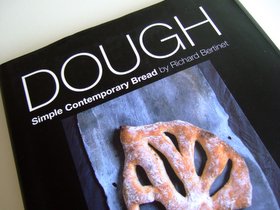
Richard’s book Dough is a million miles away from either the worthy or the fake artisan. This is bread in a lighter tradition, infused with colour and sunshine, the crunch of the baguette, the taste of the olive, and it is hugely inspiring.


He says that English home bread makers don’t know how to make dough. We put in the ingredients, flour, water, salt, yeast, and when the mass is incorrigibly porridgy what do we do? Why, we add more flour. This is quite true, I do it myself.

When a recipe says ‘ knead until the dough cleans itself off the work surface’ I know that my dough will not do that as it is far too sticky. I must have done something wrong, or the recipe is not right, or my flour is different, or, or, or.

Richard showed me how to do it his way. The recipe is not wrong. The mixture is extremely sticky. It would be impossible to knead it in the way I have been used to, with the heel of my hand.

If you add water to flour it gets sticky” he says. “And your natural reaction to sticky hands is to stop them being sticky, you don’t like the feel of the wet dough on your hands. So you add flour until the stickiness disappears. But the job of the flour is to absorb the water, which changes its consistency and structure, and if you add more flour it can’t do that. Think like a dough hook, it starts off working in the sticky mixture but it’s a dough hook so it doesn’t mind.”


Rule No 1: follow the recipe exactly.

500g strong bread flour

350g water

10g fresh yeast

10g salt


Rub the yeast straight into the flour, do not add it to water.

Add the salt and rub through.

Add the water, keeping back a little in case you don’t need it all.

Now, using a flexible plastic scraper like this, or something similar with rounded edges, incorporate the water into the flour. Turn the bowl with one hand and use the scraper with the other. You will end up with a very sticky mixture. Use the scraper to get the mixture out of the bowl.

You cannot knead this mess in the ordinary way. Indeed, Richard dislikes the word ‘knead’, he says you ‘work’ the dough. “Slide your fingers under it, like a pair of forks, with the thumbs on top; swing the mixture (which is sticky enough to be cohesive, just) upwards and then slap it back down, away from you on to the work surface. Stretch the front of the dough towards you, then lift it back over itself in an arc (to trap the air), still stretching it forwards then sideways and tucking it in around the edges. Keep repeating this sequence.”

I have quoted almost verbatim from his book, but having done it myself I have to tell you that your fingers will be stuck in the dough all the time. There is an almost irresistible urge to clean your hands. Don’t do it! You have to keep going, rocking from back foot to front foot so the tension is eased from your shoulders and you get a whole body motion going. Sort of like baking Tai Chi.

Quite soon the texture of the mess changes into a sticky dough with definite dough-like characteristics, and after a while lo! it actually starts to clean itself off the work surface! That’s the time to stop, clean off what little remains on your fingers with flour, and make the still rather wobbly dough into a ball on a floured surface.


From then on it is pretty much business as usual. You don’t slap the dough about to ‘knock it back’, you stretch and fold and tuck, trying to keep the air bubbles going. I let the dough rise for an hour, proved my loaf for an hour, baked it on a stone as usual, and it came out light and perfect.


The book, with excellent photographs, comes with a DVD. I defy anyone who reads it not to reach for the flour bag.

Dough. Simple Contemporary Bread by Richard Bertinet

Published by Kyle Cathie Limited, 122 Arlington Road, London NW1 7HP


Wednesday, July 05, 2006

Dear Francesca


On Leith Walk, in Edinburgh, there is a very famous Italian grocery called Valvona & Crolla. Established in 1934, and staffed over the years by members of both the Valvona and Crolla families, it brought authentic Italian foods and flavours to Edinburgh. Scotland has long been a third home to Italians (the second, I think it’s fair to say, being America). When I was a child, growing up in a grey part of Scotland where a red pepper would have been out of place and exotic, the one real taste was the Italian ice cream provided by Toni’s, with the raspberry sauce familiar to anyone who came from north of the border in the sixties. White and icy, it was a world away from the yellow blocks of lard sold by the big conglomerates. Round about that time I went on holiday with my family to Naples and had my first taste of something called ‘tutti frutti’ – I remember it as if it were yesterday.

Both families, the Valvona and the Crolla, came from poor peasant stock in the south of Italy. Emigrating to Scotland in the 1920s in search of a better life they found a supportive community of Italian folk who, prior to the great pizza boom, were providing ice cream and fish suppers to the local Scots, and importing Italian groceries to sell in their shops.

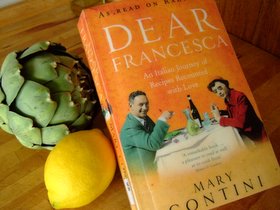
Mary Contini is part of the Crolla family, and this delightful book is written to her daughter, Francesca. She describes the background and history of her own family, their origins in the hill country of Southern Italy, and the recipes they brought with them to this foreign land. Running water was the great gift that Scotland gave in return for the wisdom and culinary lore of a century of womenfolk.

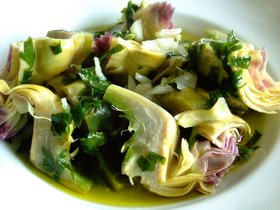
Mary Contini’s observations on food, its quality and history, coupled with a nostalgia for family traditions that have enriched their adopted land, make this a charming book. She includes careful notes on method, one of which - how to prepare artichokes – coincided with the arrival in my house of the tricky vegetable (flower bud actually), and was therefore timely.

Put some cut lemon quarters in a bowl of cold water, get a sharp knife and turn on the cold tap.


Pare down the stalk end nicely, removing some of the tough stalk fibres, and snap off the dark green spiky outer leaves just where they break until the inner pale yellow ones are revealed.


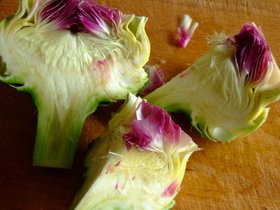
Trim off the top of the artichoke, which is spiky. Inside is revealed a beautiful magenta heart. Rub every cut surface immediately with lemon juice.


Cut the artichoke in quarters and rub with lemon juice. You can see the hairy centre. With a sharp knife cut it away otherwise its like eating a pillow.


Drop the pieces into the acidulated water as you go.


To cook as an hors d’oeuvre:

Put the quarters into a pan with:

1 clove of garlic, peeled and finely chopped

A handful of flat leaved parsley, chopped

About a teaspoon of salt

About 4-5 tbsp olive oil

Same amount of water.

Bring to the boil and then simmer gently until tender.

You might like to add some mint leaves towards the end of the cooking.

Serve warm, and mop up the juices with good bread.


Dear Francesca: An Italian Journey of Recipes Recounted with Love, by Mary Contini

Published by Random House, Ebury Press

 
Creative Commons License
This work is licensed under a Creative Commons Attribution-NonCommercial-NoDerivs 2.5 License.